
The Stack
How I named a brand by making Claude check 20 domains in 4 seconds.
I named this brand and stood it up on a live server in an afternoon, and I barely touched the keyboard for the mechanical parts. I described what I wanted; the agent checked the domains, short-listed what was free, and — once I approved — created the server account it runs under.
The interesting thing about that isn’t the speed. It’s that the whole job divides cleanly into two piles, and only one of them was mine to do. That division is the actual skill in working with an AI agent on real infrastructure, so this post is really about that — with naming as the worked example, because naming is the cleanest case of the one pile you can never delegate.
The division of labor
When people picture “letting an AI do it,” they think the question is how capable the agent is. On real work, that’s the wrong question. The agent is genuinely excellent at the reversible, mechanical half — searching, checking, configuring, retrying, routing around small surprises. What it cannot do is own the decisions you can’t take back. Those stay with you, and your whole job is to know which ones they are and spend your attention there.
Launching a brand is almost entirely reversible. You can rewrite every post, redo the logo, change hosts, swap the newsletter provider — all cheap. Exactly one early decision is not: the name. So that’s the one I did myself, and everything downstream of it I handed off.
What only I could bring: the constraints
Before the agent checked a single domain, I gave it the judgment it can’t have — the criteria a name has to clear:
- It represents the thing. The name should say what the brand is, or at least not fight it.
- Short, and easy to remember and to type. Every extra character is a place to lose someone.
- Not crowded by a bigger brand’s variant spellings. If
honestmachines,honest-machines, andgethonestmachinesall point at someone larger, you’ll spend forever in their shadow. - Available as a
.com. These are meant to become commercial, and.comis still the default people’s fingers type. - Cheap. I’ve never paid more than $12 for a year, and I still land names like
cubbywise. If a name is only “available” at a $2,900 premium tier, it is not available. - Bonus: broad enough to outlive its first idea, so if the project dies the domain can host the next one.
Taste and failure-thinking are the parts no agent has. Everything after this list is mechanics.
What I handed to the agent: the search
Instead of pecking names into a registrar’s search box one at a time — slowly, emotionally,
with a “buy now before it’s gone!” timer ticking — I gave the agent about twenty candidates and
said check these. It used RDAP, the modern structured replacement for whois: it answers
over plain HTTP, and a 404 means nobody owns the domain. One pass, whole list, a sorted table
back before my coffee was ready.
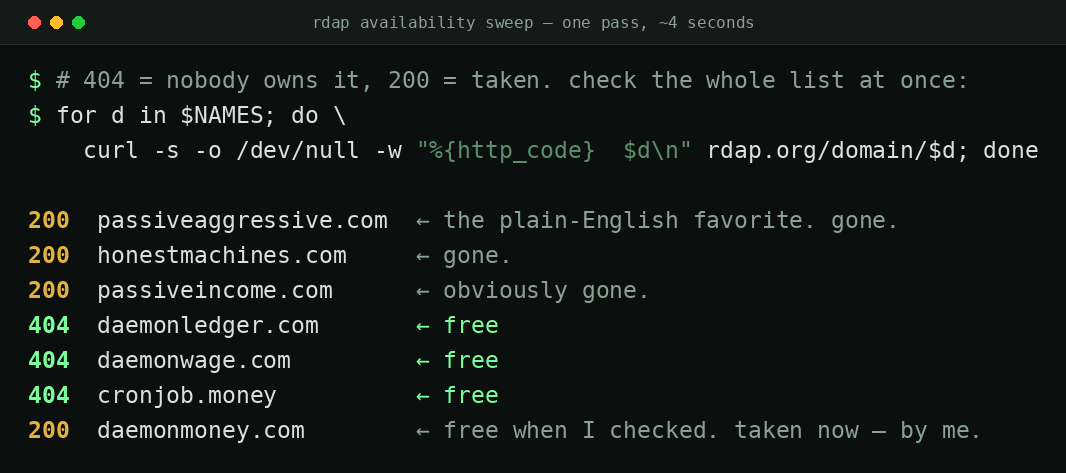
rdap.org routes each query to the right registry,
so one loop covers every TLD — 404 is good news. Note the pattern: every plain-English name is
taken, and the free ones are all coined or compound. There’s a second constraint
hiding here too — the name has to be free as a handle, not just a domain, and
that’s where my actual favorite died. “Passive Aggressive” had a gettable .com and
a long-gone Instagram handle. Real words are claimed everywhere; coined marks are how you win
the domain and the handle at once.Why the name gets my full attention: a migration receipt
Here’s why naming is the piece I refuse to delegate, stated as a real number rather than a principle. A little while ago I rebuilt my long-running trading-card blog from WordPress onto a bare static site. Same domain — I didn’t change a single letter of the address. That “just the internals” rebuild still cost me a solid month of hunting down 404s and coaxing Google to re-index everything, and six weeks later the traffic is only now climbing back to where it was.
That was the easy version of a migration. Now imagine changing the domain itself — after a year of Google building authority on the old name, after that name has quietly leaked into a hundred of your own posts, image captions, and other people’s links. I can’t imagine it, and I don’t want to. Which is the whole point:
Naming is the one step an agent can’t rescue you from later. So you spend your few hours on it up front — even on a project you fully expect to fail. If it’s worth $12 to register, it’s worth a few hours to name right.
Register cheap, on purpose
The mechanics, for the record: I register at Namecheap (I trust them), and move a domain’s DNS to Linode or Cloudflare once a project actually starts taking off. Everything stays at the cheapest tier — deliberately. Most of these experiments will die, and a graveyard of $12 domains is a rounding error, while a graveyard of premium domains is a bad habit. Cheap domains are how you give yourself permission to fail — which, on a fleet built to run the long game, is the permission that matters most.
The name was already taken — by 1975
The last mechanical step was creating the server user, since every brand on my box runs as its own
Unix account. I told the agent to make it and call the account daemon. Unix said no.
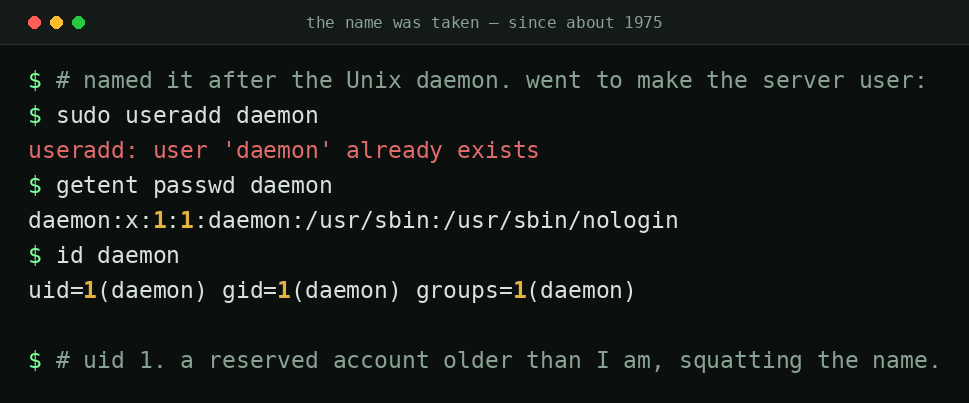
nologin service account that’s shipped with Unix
since roughly the mid-1970s. My brand’s own namesake was squatted before I was born.The name is a background process — the thing that quietly runs your jobs while you’re logged off,
which is exactly what every engine in this fleet is (and where the mascot’s name, nohup, comes
from too). Fitting, then, that when the agent hit a fifty-year-old reserved account, it simply
adapted to daemonmoney and kept moving — no stall, no question for me. That’s the texture of the
whole collaboration: I own the one call I can’t undo, and the agent absorbs the dozen little
surprises that would each have cost me a context-switch.
Next in the log: what happens when the stakes aren’t low — setting up an email list off this thing, and the moment I let the agent onto the mail server and it quietly crossed two of my brands’ mail before I caught it with a single question.